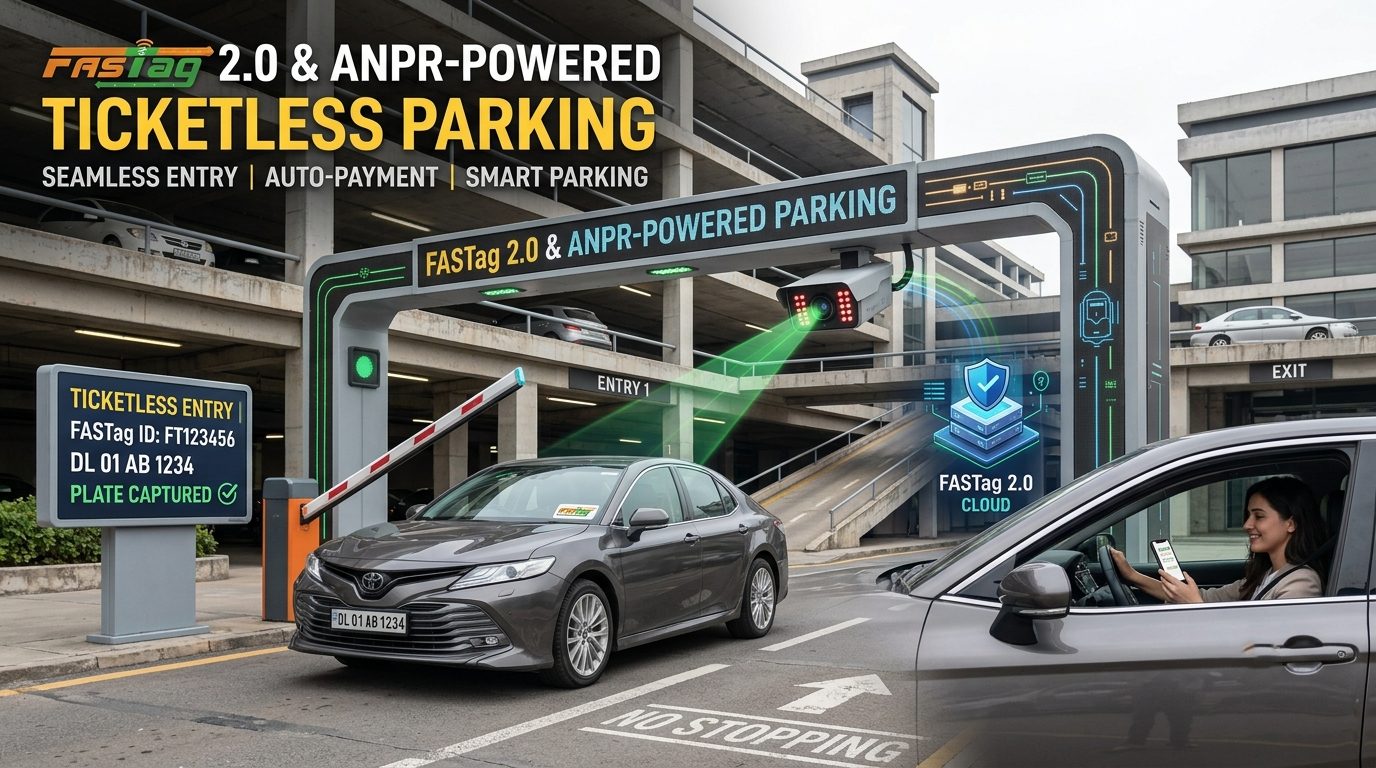
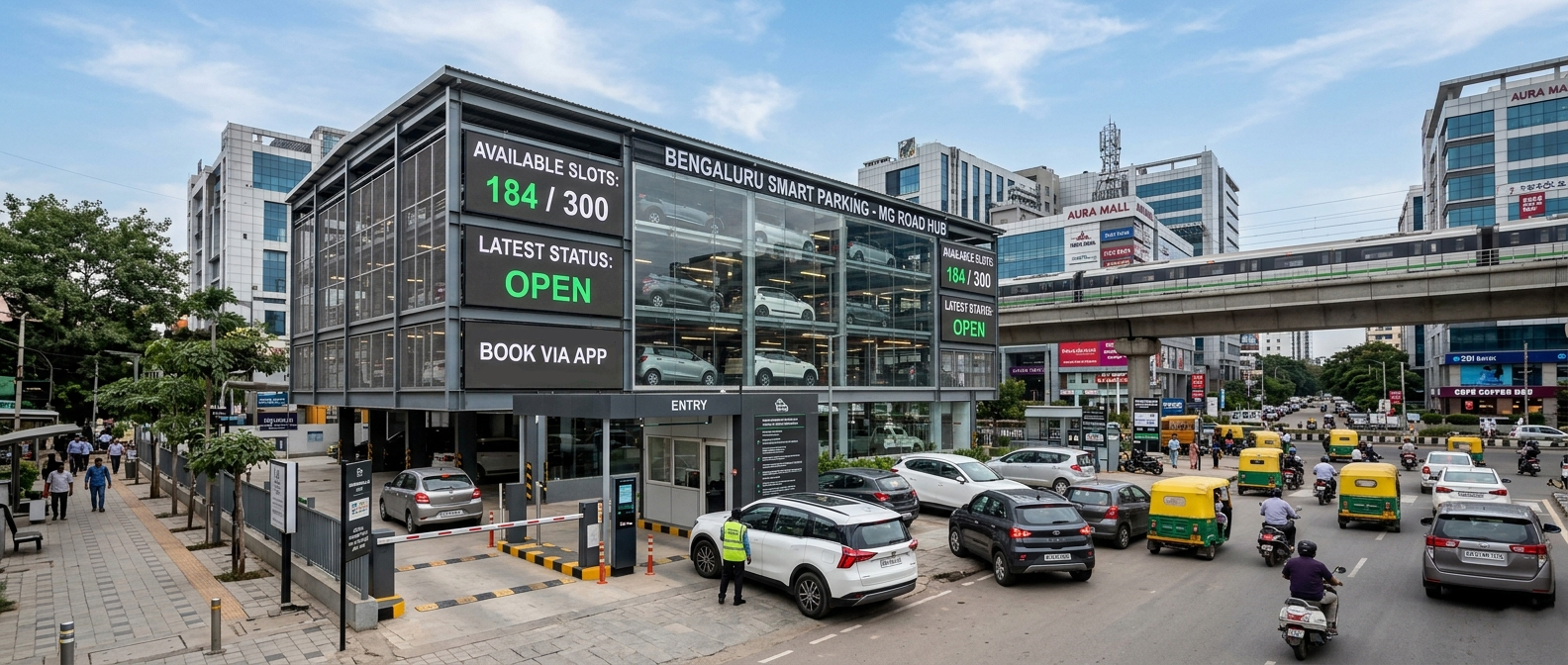
India’s cities are growing faster than their infrastructure can keep up. Over 340 million registered vehicles now compete for road space and parking across urban centers never designed for this scale. In cities like Bengaluru, Mumbai, and Delhi, drivers spend significant time every day simply searching for a place to park. Research consistently shows that parking-related cruising contributes up to 30% of inner-city traffic congestion. Smart parking in India is emerging as a direct response to this pressure.
The Indian government’s Smart Cities Mission launched in 2015. It gave urban local bodies a structured mandate and funding pathway to modernize infrastructure. Smart parking featured as a priority component across dozens of city proposals. Since then, several Indian cities have moved from planning to active deployment, with measurable outcomes. This article examines where that growth is happening, what it looks like on the ground, and what early adopters have learned along the way.
The Scale of India’s Parking Problem
Before looking at solutions, it helps to understand the size of the challenge. India added over 25 million new vehicles to its roads in 2022 alone. By 2025, that annual figure is expected to cross 30 million. Urban areas absorb the bulk of this growth, yet parking supply has not kept pace with demand by any meaningful margin.
Bengaluru and Pune rank among the most congested cities globally, according to the TomTom Traffic Index. Average traffic speeds in Bengaluru hover around 18 kilometers per hour during peak hours. In Pune, the figure sits similarly low at 19 kilometers per hour. Both cities trace a significant portion of this congestion to inadequate and disorganised parking. Vehicles occupying footpaths and intersections worsen the situation because no structured parking alternative exists nearby.
Furthermore, the India parking systems market reflects this urgency. It was valued at approximately USD 435 million in 2023 and is projected to reach USD 653 million by 2032. Within that broader market, the smart parking segment is growing considerably faster, at a projected compound annual growth rate of around 13% through 2030. This trajectory signals a clear shift in how Indian cities are approaching the problem.
Why traditional approaches are failing
Several cities including Delhi, Chandigarh, and Pune have attempted to address parking through policy alone. Fixed-rate street parking, designated zones, and enforcement drives are the typical tools. However, these measures consistently fall short because they address supply without managing demand. Minimal pricing regardless of actual demand, illegal encroachment of public spaces, and weak enforcement have left most Indian cities with the same structural problem despite years of policy attention.
Smart parking technology offers a different approach. Rather than simply adding more spaces, it makes existing spaces work more efficiently through real-time monitoring, demand-responsive pricing, and data-driven enforcement.
Delhi: AI-Powered Guidance in Congested Commercial Zones
New Delhi presents one of the most studied examples of smart parking research and deployment in India. A 2025 study published in the Journal of the Institution of Engineers India developed and tested the Optimal Parking Space Allocation Model, known as OPSAM, across commercial hubs in Central Delhi. The tested areas included Chandni Chowk and Karol Bagh.
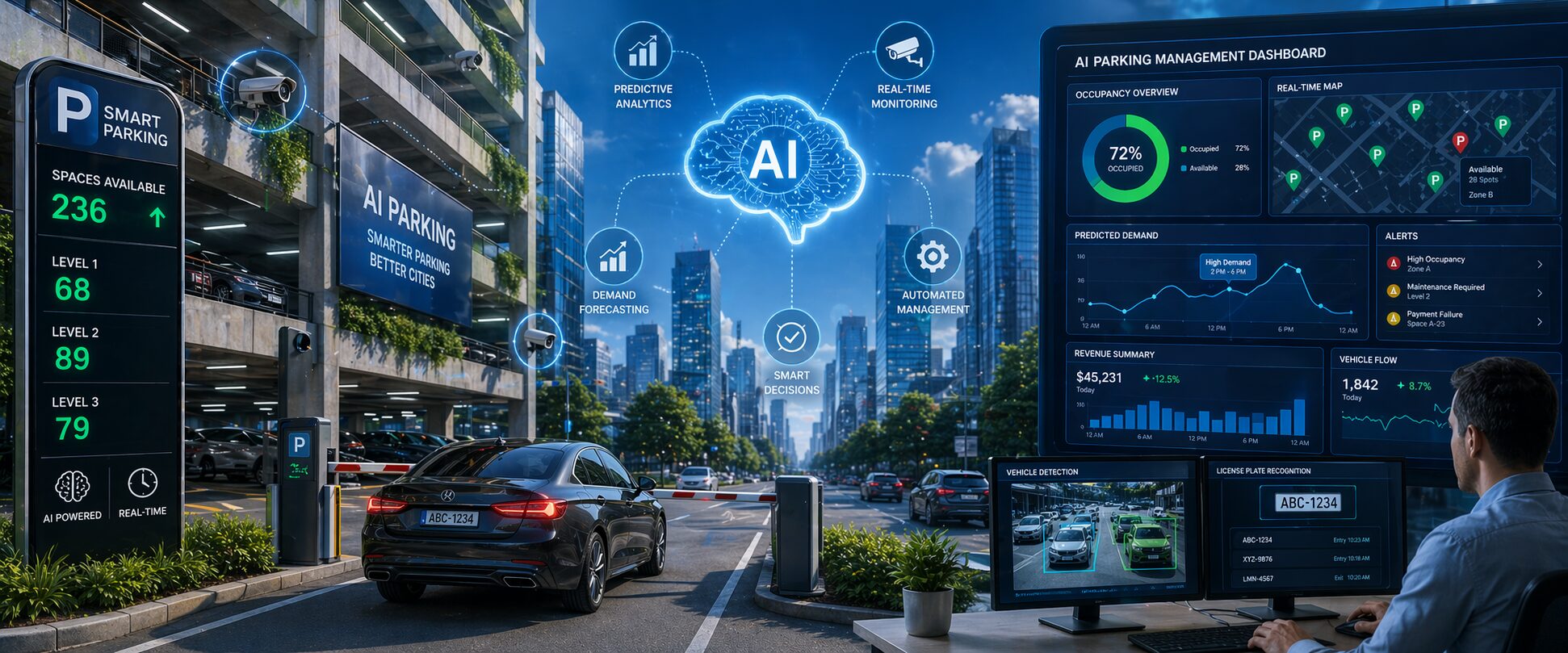
OPSAM uses the YOLO-v4 computer vision algorithm to detect parking space availability through cameras. It processes data in real time and directs drivers to open bays via a parking guidance and information system. The results were notable. The system achieved a 20% reduction in parking search times in tested zones. It also improved parking occupancy rates from 70% to 85%, meaning more of the available space stayed in active use at any given time.
The study also revealed a meaningful insight about driver behaviour. Around 41% of surveyed drivers in Central Delhi already use Google Maps to navigate to parking. This shows a population ready for app-integrated parking guidance. What has been missing is the real-time data layer to feed those navigation tools with accurate, live parking information.
Delhi’s experience demonstrates both the potential and the gaps. Pilot deployments show strong results. However, scaling from a research trial to a city-wide system requires sustained investment in camera infrastructure, reliable internet connectivity, and a centralised data management platform. All of these remain works in progress.
Bengaluru: On-Street Smart Parking Rolls Out Across 85 Locations
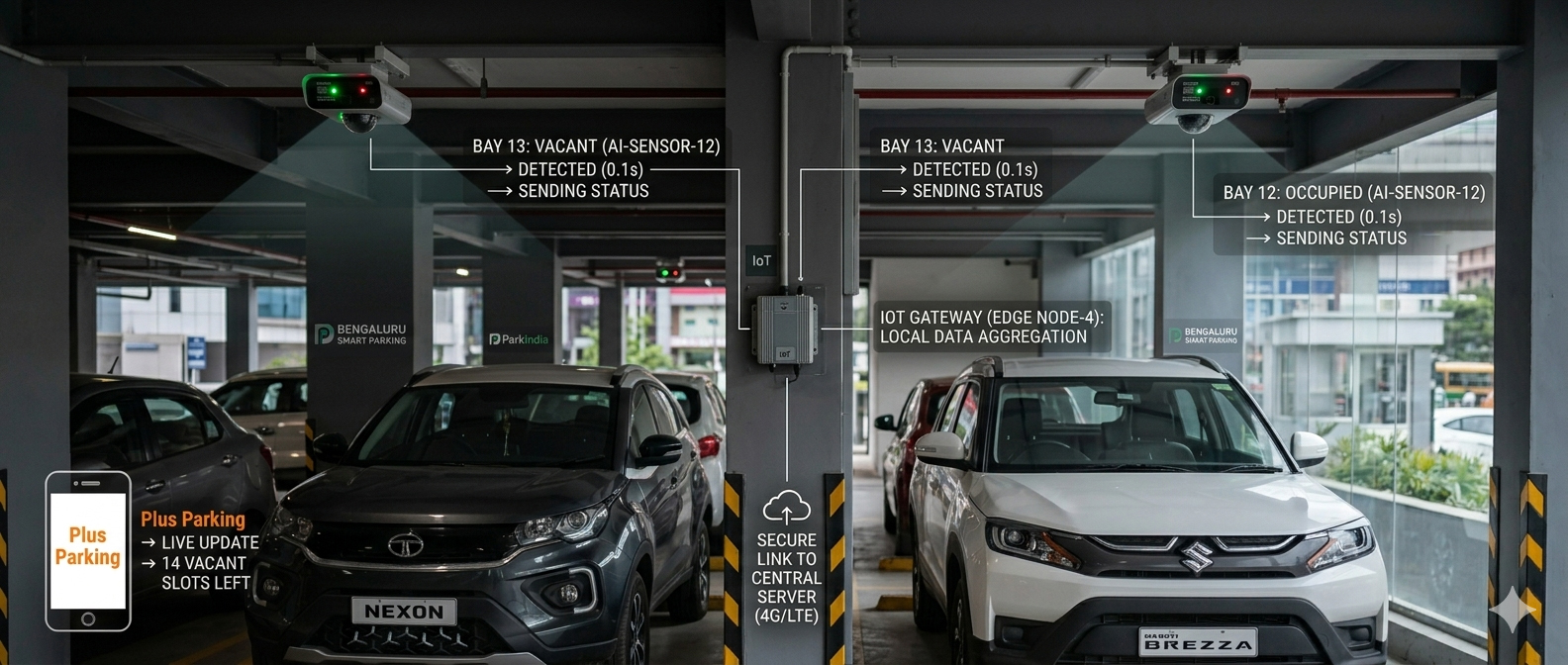
Bengaluru has taken a more operationally concrete step. The Bruhat Bengaluru Mahanagara Palike introduced automated on-street pay-parking across 85 locations in the city. Electronic sensors at each parking bay monitor entry and exit times. CCTV cameras provide additional surveillance and detect illegal parking.
The system includes automatic ticket generation and cashless payment options. This removes the friction of coin-operated meters and cash-based transactions that characterise most Indian street parking. Drivers receive time-stamped tickets digitally, and the city gains continuous occupancy data across all monitored bays.
This deployment is significant for two reasons. First, it moves smart parking from private facilities like malls and IT parks, where adoption has been relatively straightforward, into public on-street space. Managing public space is considerably more complex. Second, it demonstrates that Indian urban local bodies are willing to invest in the operational infrastructure needed to enforce smart parking rules, not just install sensors and hope for compliance.
Bengaluru is also home to a large concentration of IT parks around Whitefield and Electronic City. Private operators such as International Tech Park Bengaluru have deployed structured parking management systems across their campuses. These private deployments provide a useful parallel track. Innovation in a controlled environment feeds learnings back into broader urban deployments over time.
Mumbai: Market Pressure Drives Automated Parking Solutions
Mumbai faces a parking challenge unique in its intensity. Land costs in prime commercial areas like Lower Parel and Bandra-Kurla Complex exceed one lakh rupees per square foot. At those valuations, dedicating large floor plates to conventional parking is economically indefensible.
This commercial pressure has accelerated automated and robotic parking adoption in Mumbai faster than policy mandates alone could have achieved. In 2023, a 12-storey robotic parking tower opened in Lower Parel. The system uses mechanical platforms and software to stack vehicles vertically. It cuts the space required per car from roughly 25 to 35 square metres in a conventional layout down to just 10 to 15 square metres. Vehicle retrieval takes two to three minutes via an RFID or face ID interface.
Beyond robotic parking, Mumbai accounts for approximately 28% of India’s parking management software market by regional share. IoT-based parking management systems are active across major commercial properties, hospitals, and residential complexes. Operators like Secure Parking manage facilities across the city as part of a network spanning 40 Indian cities and over 275,000 parking bays nationwide.
Mumbai’s trajectory illustrates how economic necessity drives technological adoption at a pace that public policy alone rarely achieves. When land is expensive enough, smart parking stops being an upgrade and becomes a financial requirement.
Pune and Surat: Smart Cities Mission in Action
Pune and Surat rank among the most active Smart Cities Mission cities in India in terms of implemented projects. Both have pursued smart transportation as a core component of their smart city strategies. Parking forms part of a wider effort to reduce congestion and improve urban mobility across both cities.
Pune, ranked among the most congested cities in Asia, adopted a notably resident-led approach to smart city planning. Over 12,000 residents participated in consultations that shaped infrastructure priorities, including parking. The city’s urban redesign process added two-way traffic flow, wider footpaths, and improved parking management on key commercial streets. Pimpri-Chinchwad, Pune’s twin city, has similarly engaged with smart parking as part of its municipal corporation’s broader urban mobility agenda.
Surat has pursued smart parking as part of its integrated command and control centre model. Multiple urban systems including traffic, surveillance, and parking feed data into a centralised city management platform. This integration is precisely what makes smart parking most effective. When occupancy data connects to traffic management, the city can respond to congestion proactively rather than reactively.
Both cities demonstrate that the Smart Cities Mission has created genuine momentum for parking technology adoption despite uneven outcomes nationally. The funding framework and accountability structures of the mission have pushed local bodies to commit to deployments that might otherwise have remained proposals indefinitely.
What India’s Smart Parking Growth Tells Us
Across these cities, a few consistent themes emerge for developers, operators, and policymakers thinking about smart parking in the Indian context.
Technology choice matters enormously. Earlier Indian smart parking deployments relied on localised wireless area networks. They suffered from poor battery life, high maintenance costs, and inconsistent data quality. Cities and operators that have shifted to LoRaWAN and NB-IoT for sensor communication are seeing more reliable results. Camera-based systems with computer vision offer a more scalable path for covering large numbers of spaces at lower per-bay cost than individual ground sensors.
Private sector deployment is outpacing public deployment. The most mature smart parking infrastructure in India currently sits in private commercial properties. IT parks, malls, hospitals, and airports give operators full control over the deployment environment and a direct revenue incentive to optimise performance. Public on-street smart parking is more complex to implement and enforce, but cities like Bengaluru are demonstrating that it is achievable.
Integration with navigation platforms is the missing link. Delhi’s research showed that drivers already use Google Maps and similar tools to look for parking. The next step is connecting live parking occupancy data from Indian city systems into these navigation platforms. Drivers should receive parking guidance as part of their journey, not as a separate afterthought on arrival.
Finally, the equity dimension requires deliberate attention. Dynamic pricing, if implemented without safeguards, risks concentrating affordable parking away from lower-income drivers. Indian cities adopting demand-responsive pricing should build income-sensitive provisions into their frameworks from the outset rather than retrofitting them later.
Frequently Asked Questions
What is smart parking in India?
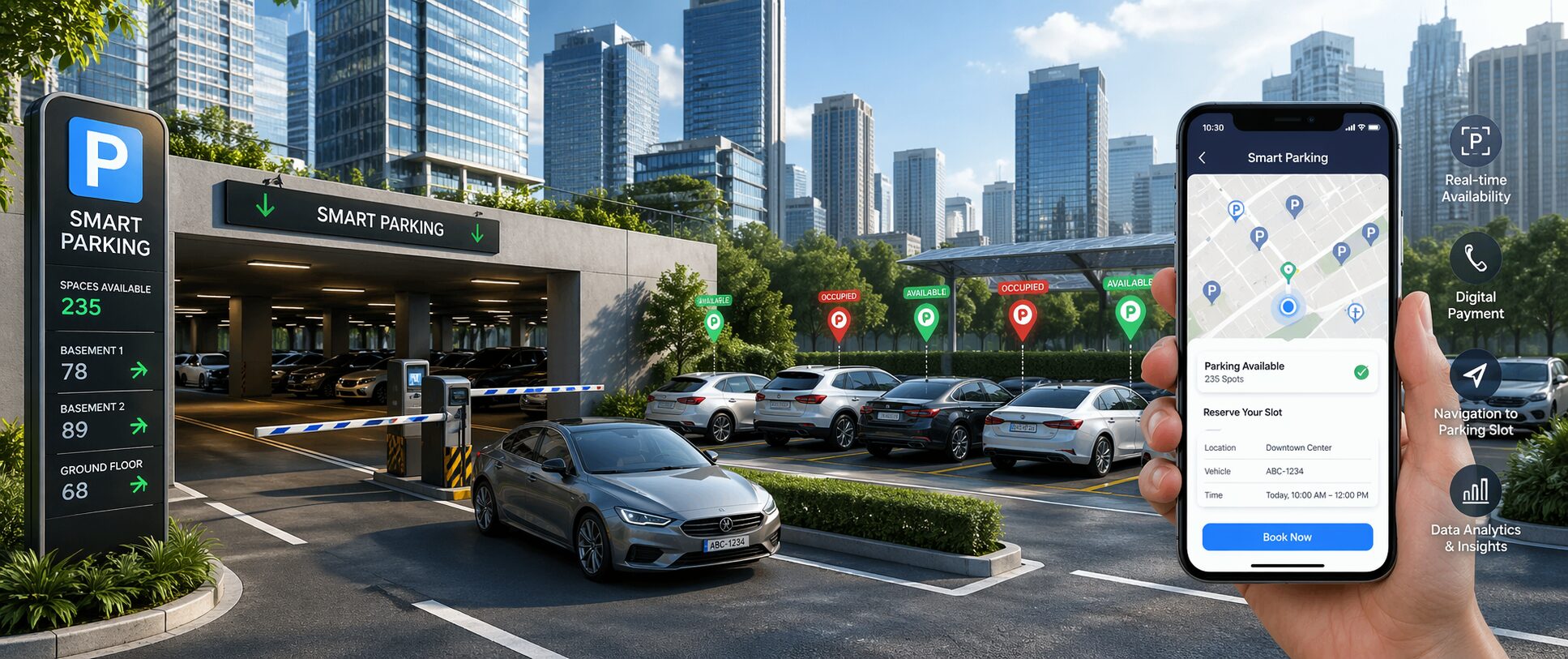
Smart parking in India uses sensors, IoT technology, cameras, and mobile apps to detect real-time parking availability and guide drivers to open spaces. It is a key component of India’s Smart Cities Mission and operates across both public on-street locations and private commercial facilities.
Which Indian cities have smart parking systems?
Delhi, Bengaluru, Mumbai, Pune, Surat, Hyderabad, and Chennai are among the leading adopters. Private smart parking management is also active in major IT parks, airports, hospitals, and shopping centres across these and other cities.
What is India’s Smart Cities Mission and how does it relate to parking?
The Smart Cities Mission, launched in 2015, provides funding and a framework for 100 Indian cities to modernise urban infrastructure using technology. Smart parking is a priority component. Several cities use mission funds to deploy sensors, guidance systems, and integrated command centres.
How fast is the smart parking market growing in India?
The broader India parking systems market is growing at a CAGR of around 4.6% through 2032. The smart parking segment within it is growing considerably faster at approximately 13% annually, driven by urbanisation, vehicle growth, and the expansion of smart city programmes.
What are the main challenges for smart parking adoption in India?
Key challenges include high upfront infrastructure costs, inconsistent connectivity in dense urban areas, and integration with legacy payment and enforcement systems. Stronger public policy frameworks are also needed to support demand-responsive pricing and enforcement in public spaces.