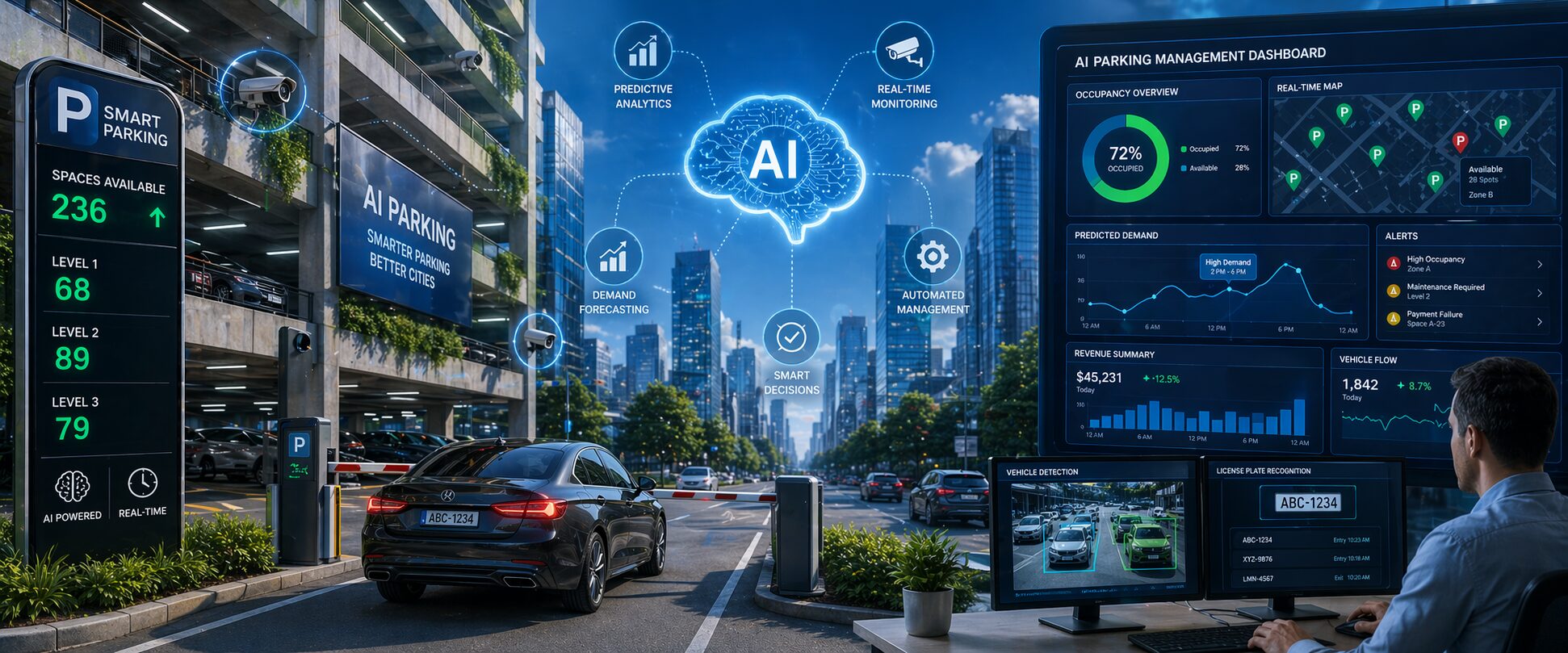
Parking management has historically been a manual, reactive process. Attendants collect tickets, meters run on fixed schedules, and enforcement officers patrol streets on foot. It works — but barely. As cities grow and vehicle ownership rises, the cracks in this model are becoming impossible to ignore. Artificial intelligence is changing the equation entirely.
AI in parking management is not a distant concept. In fact, it is already running in cities, airports, hospitals, and commercial properties around the world. From predicting when a parking lot will fill up to automating enforcement without a single officer on patrol, AI is making parking smarter, faster, and more profitable for operators — while meaningfully improving the experience for drivers.
What AI-Powered Parking Management Actually Means
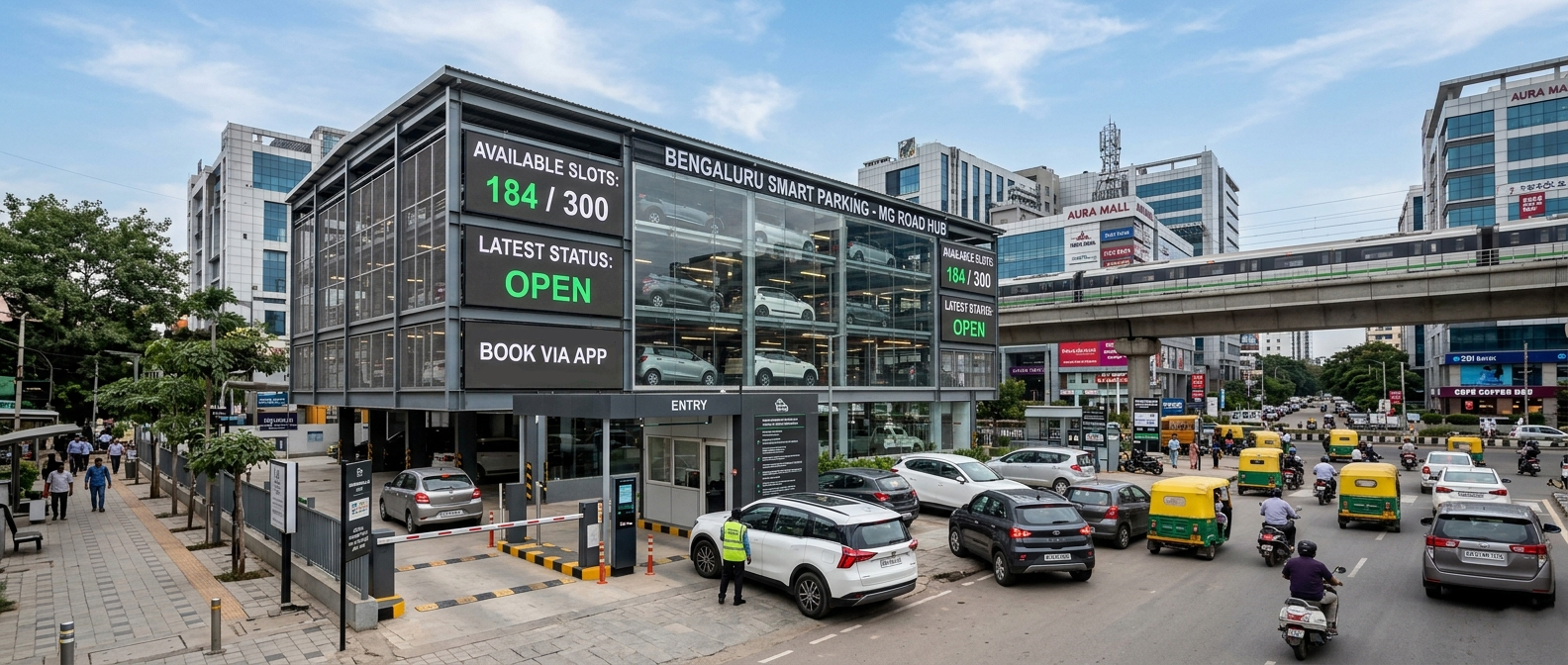
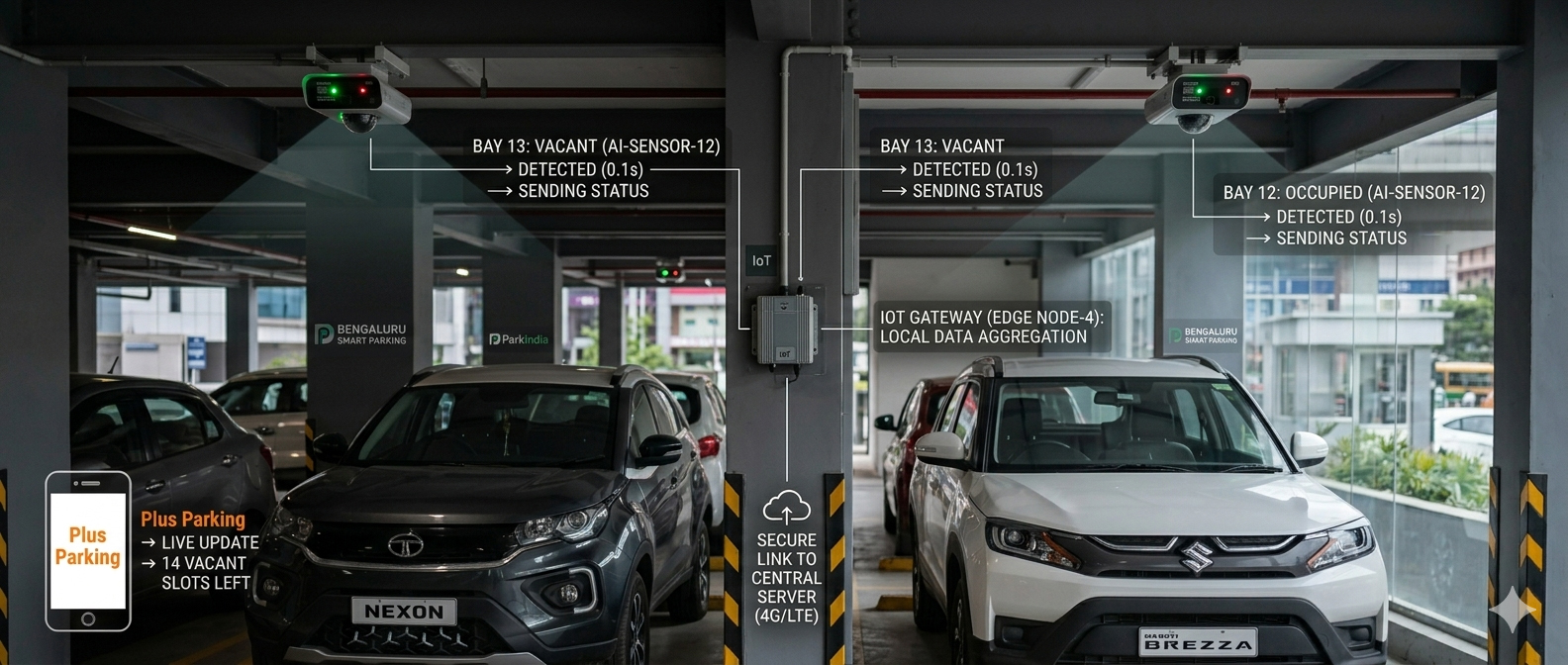
AI parking management refers to the use of machine learning, computer vision, and predictive analytics to automate and optimize how parking facilities are run. Specifically, it goes several steps beyond traditional smart parking, which primarily focuses on detecting and displaying real-time availability.
Where a standard sensor tells you a space is occupied, an AI system asks why, for how long, and what that means for the next two hours. Moreover, it learns from patterns over time, adapts to events and seasonal shifts, and makes decisions — on pricing, enforcement, routing, and staffing — that would otherwise require human judgment.
The shift from sensor-based parking to AI-driven parking management is the difference between a thermometer and a thermostat. One reports; the other acts.
Predictive Occupancy and Demand Forecasting
One of the most valuable applications of AI in parking is predicting demand before it arrives. Traditional systems show drivers what is available right now, whereas AI systems show operators and drivers what will be available in 30, 60, or 90 minutes — with measurable accuracy.
These prediction models are trained on months or years of historical occupancy data, combined with external signals such as local event calendars, public holiday schedules, weather forecasts, and live traffic data. A stadium parking facility, for example, can predict near-exact arrival and departure curves for a sold-out concert based on historical patterns from previous events of similar size and timing.
Why this matters for operators
Demand forecasting allows operators to prepare rather than react. Staff scheduling becomes precise rather than approximate. Furthermore, pricing adjustments happen hours in advance rather than in response to a lot that is already full, and overflow arrangements with nearby facilities can be activated before congestion builds.
Why this matters for drivers
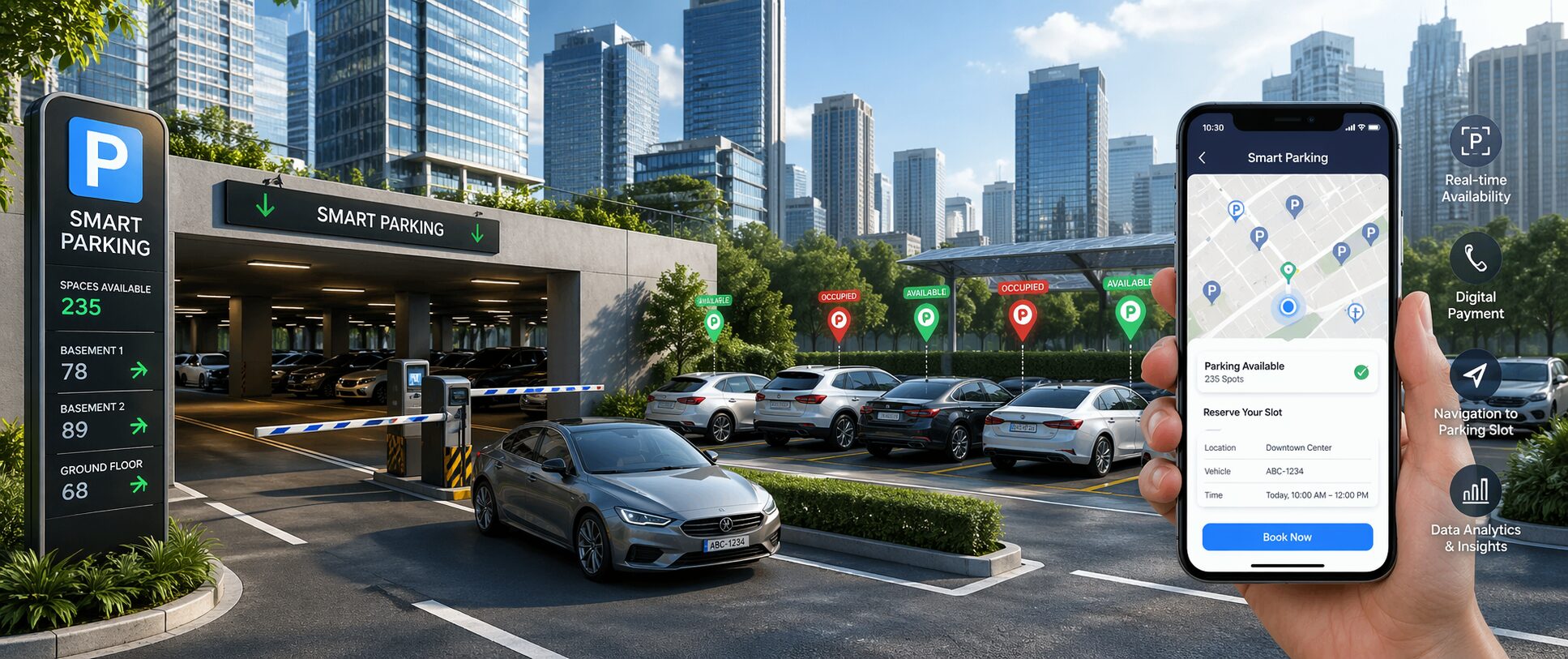
Drivers using apps connected to AI-powered parking platforms receive availability predictions as part of their navigation experience. Rather than arriving at a destination only to find no spaces, they are actively guided to the right facility before the problem occurs.
Computer Vision and Automated Enforcement
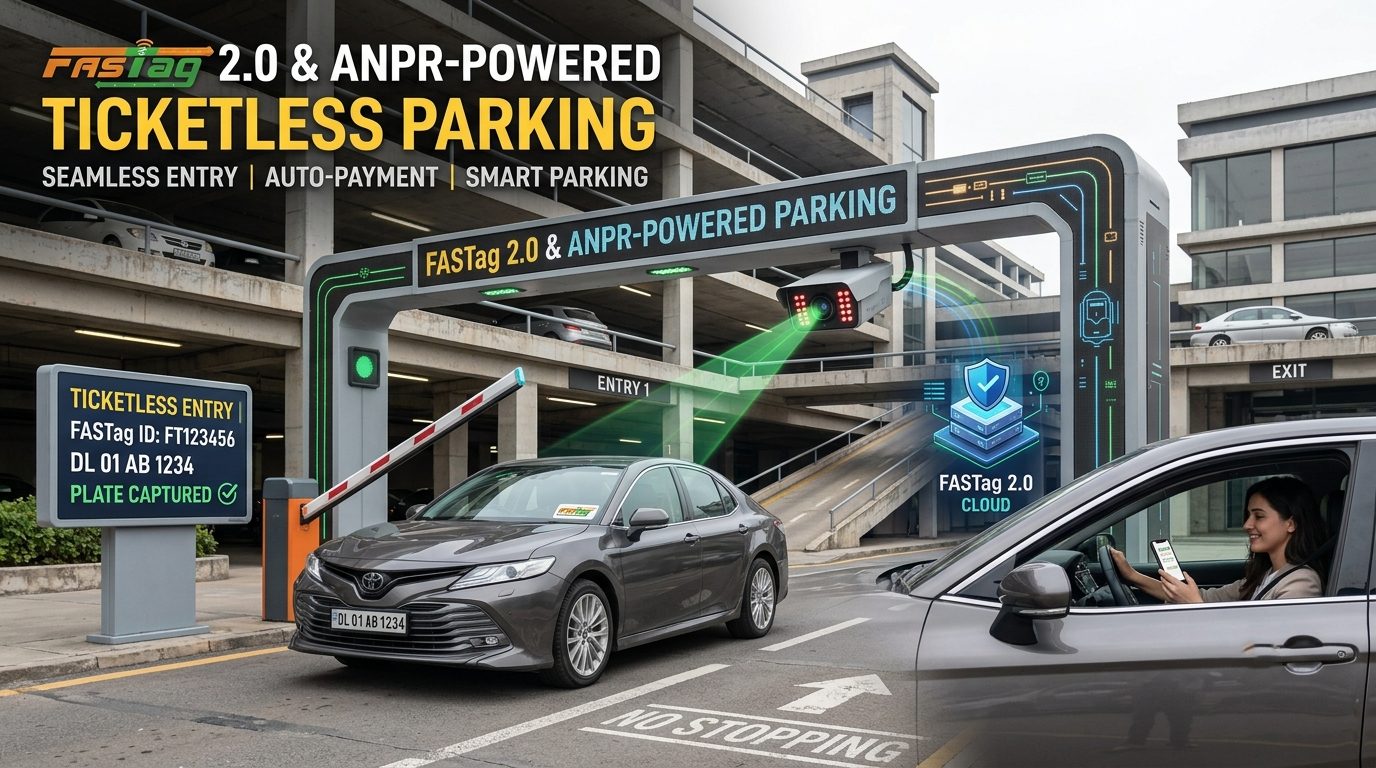
License plate recognition is not new, but AI has transformed it from a slow, error-prone process into a fast, highly accurate, and fully automated enforcement system.
Modern AI-powered cameras — mounted at entry and exit points or on mobile patrol vehicles — scan license plates in real time and instantly cross-reference them against databases of permits, payment records, and violation histories. The entire process takes milliseconds. As a result, false read rates have dropped to under 1% in leading systems, meaning a single camera can effectively replace multiple enforcement officers, operating continuously and without the inconsistency of human patrol patterns.
Beyond plate recognition
Computer vision in parking is expanding well beyond plates. Today, AI models detect vehicle type and size to assign spaces appropriately, identify disabled bay misuse without requiring a human on-site, and flag vehicles that exceed their time limit automatically. Additionally, these systems monitor for safety issues such as wrong-way driving within parking structures.
Notably, some systems also detect fraudulent behavior — such as drivers swapping tickets between vehicles — a persistent problem in traditional multi-story facilities that proves nearly impossible to catch through manual patrols alone.
Dynamic Pricing Driven by Machine Learning
Dynamic pricing in parking is not new, but what AI adds is a level of precision and responsiveness that rule-based systems simply cannot match.
A rule-based system might say: raise prices by 20% when occupancy exceeds 85%. By contrast, an AI pricing engine continuously evaluates dozens of variables — current occupancy, time of day, day of week, weather, nearby events, historical demand curves, and real-time traffic inflows — and sets a price that reflects actual market conditions at that specific moment.
The goal is not to maximize revenue in isolation. Instead, the best AI pricing models optimize for a target occupancy rate — typically around 85% — that keeps spaces available without leaving money on the table. This approach has increased parking revenue by 10 to 30% in documented deployments, while simultaneously improving availability for drivers.
Over time, the model learns which price points work best in which conditions for a specific facility. Consequently, a system with one month of data already outperforms a rule-based model, and after a full year of learning, that performance gap widens considerably.
AI in Parking Navigation and the Driver Experience
The driver-facing improvements from AI go beyond simply knowing where a space is available. Rather, AI enables a fundamentally different parking experience from the moment a driver begins their journey.
Next-generation parking apps use AI to recommend the best parking option based on a driver’s destination, willingness to walk, current pricing across nearby facilities, and predicted availability at arrival time. Because the recommendation accounts for all these factors together, it feels personalized rather than generic.
Inside the parking structure
AI-powered guidance systems learn which entry points, ramps, and sections fill first, then adjust real-time routing accordingly. Rather than directing every driver to the same floor until it fills, the system distributes traffic intelligently — reducing internal congestion and cutting the time drivers spend navigating within the structure itself.
Beyond routing, some advanced deployments are integrating conversational AI at kiosk entry points — voice-activated interfaces that process payments, answer questions, and handle exceptions without any staff involvement.
Challenges of Implementing AI in Parking
AI-powered parking management delivers clear benefits, but implementation is not without complexity.
Data quality is the foundation of any AI system, and predictive models are only as accurate as the historical data behind them. Facilities with incomplete records, inconsistent sensor coverage, or aging infrastructure will see limited results until those underlying issues are resolved. Consequently, investing in data quality is not optional — it is a prerequisite.
Integration with existing systems presents another common challenge. Many parking operators rely on legacy access control and payment platforms that were never designed with AI in mind. Therefore, deploying AI on top of fragmented infrastructure often requires middleware, open APIs, and significant IT investment before the benefits become visible.
Privacy regulation adds a further layer of consideration. Because AI systems using computer vision and license plate recognition collect detailed data about drivers, they are subject to data protection laws that vary by country and municipality. Operators must actively ensure compliance around data retention, consent, and surveillance — and communicate these practices clearly to the public.
Finally, there is the question of equity. AI-driven dynamic pricing risks making parking unaffordable during peak hours for lower-income drivers. To address this, responsible deployments should include price ceilings, affordable parking designations, or subsidy mechanisms that ensure the benefits of AI optimization are broadly shared.
Frequently Asked Questions
How does AI improve parking management?
AI improves parking management by automating enforcement, predicting demand before it occurs, optimizing pricing in real time, and giving drivers accurate availability information before and during their journey.
What is the difference between smart parking and AI parking management?
Smart parking primarily uses sensors to detect and display real-time occupancy. AI parking management goes further by using machine learning to predict future demand, automate decisions on pricing and enforcement, and continuously improve performance based on accumulated data.
Is AI parking technology expensive to implement?
Initial costs vary depending on facility size and existing infrastructure. However, most operators recover those costs through increased revenue, reduced staffing needs, and improved operational efficiency within two to four years of deployment.
Which industries benefit most from AI parking management?
Airports, hospitals, shopping centers, sports venues, and urban municipal parking operations benefit most, primarily due to high volumes, variable demand patterns, and the complexity of managing large numbers of spaces across multiple facilities.